
At first glance it looks like an ordinary late nineteenth-century book. Closed, it appears quite unassuming.
But tilt it, just slightly, and Adelaide reveals itself.
Hidden along the outer edges of the pages is an enchanting image of King William Street. On the left stands Adelaide’s Town Hall and opposite, the General Post Office anchors the scene among neighbouring buildings. A cart, or perhaps an early horse-drawn tram, passes in front of the GPO. There’s a suggestion of movement and early morning life unfolding in the heart of a growing city.
This is the rare and delightful art of hidden fore-edge painting.
Fore-edge illustration is created on the edges of a book’s pages, traditionally with gold or silver gilding. Sometimes artists paint full images across all three edges, known as all-edge painting. But hidden fore-edge painting takes the illusion one step further.
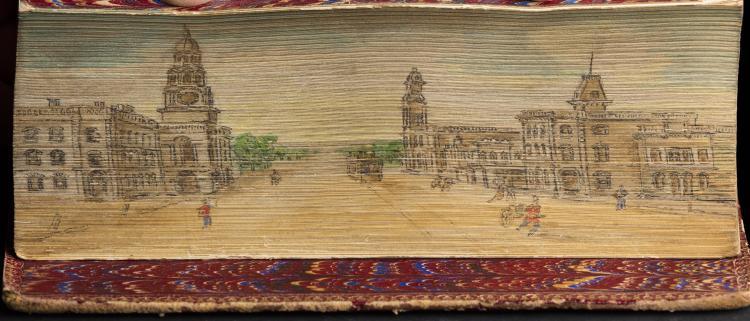
The artist gently fans the pages by pressing the spine back, revealing only a sliver of each page edge. It’s here, on this narrow and staggered surface, that the image is painted. When the book is closed, the artwork vanishes entirely. Only when the pages are carefully spread does the scene appear, as if by magic.
Use the slider to reveal the hidden picture
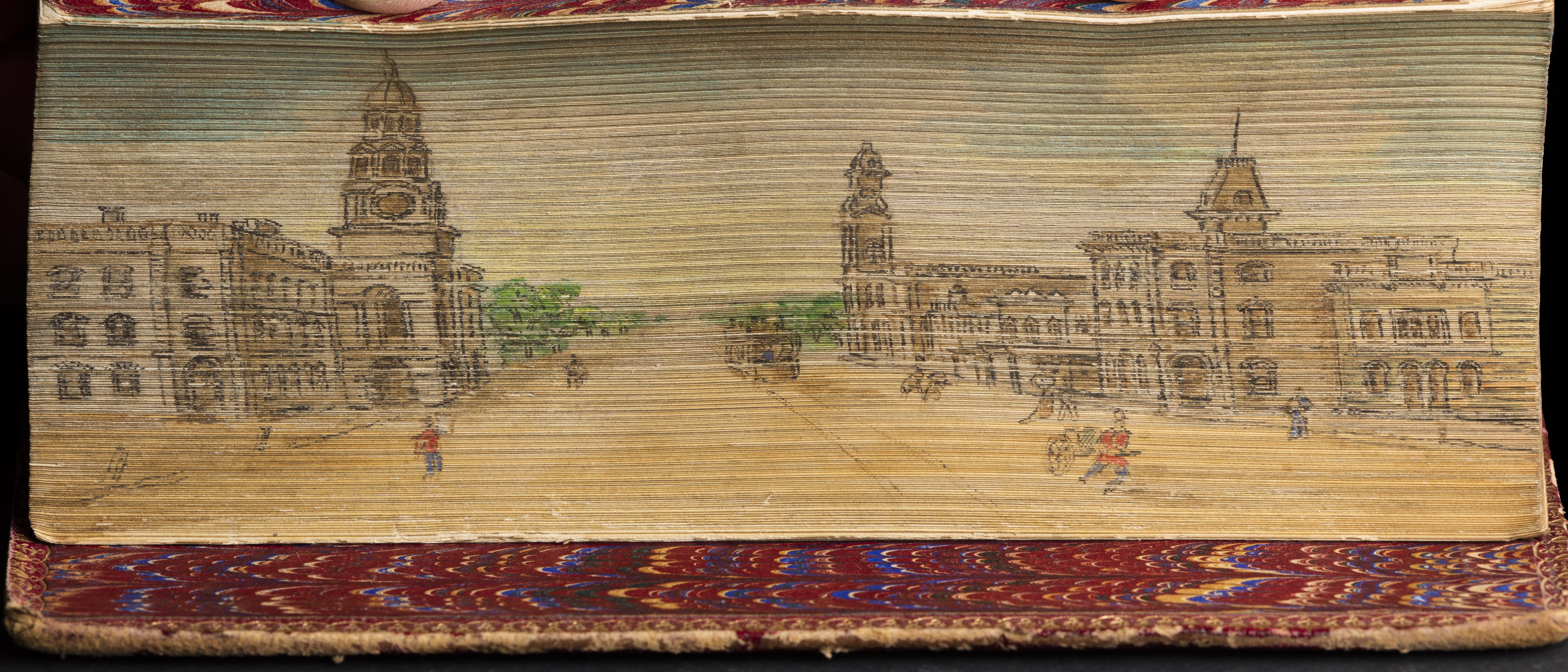
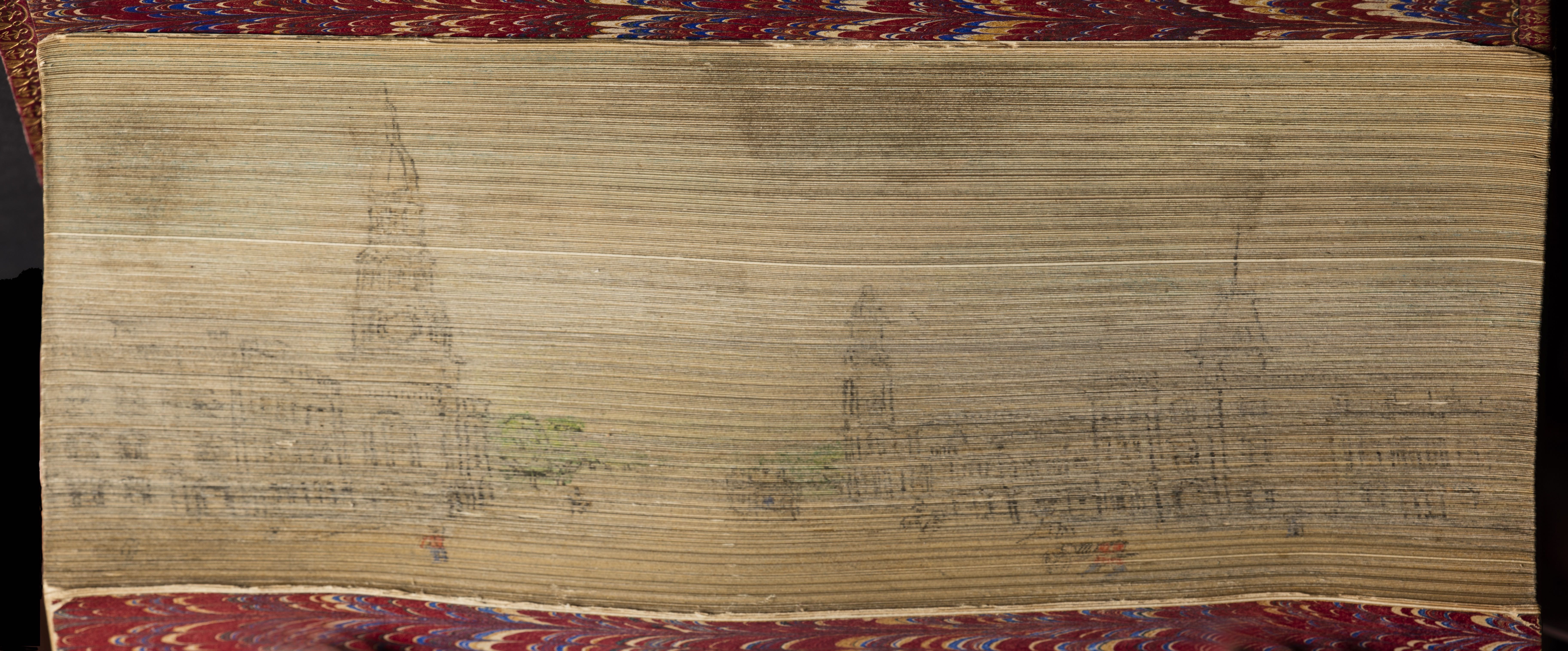
In rare cases (although not represented in the State Library’s collection), artists painted both sides of the hidden fore-edge – two secret images concealed within a single volume!
Look closely at this streetscape and you can pinpoint the artist’s perspective. The viewpoint appears to be from the centre of King William Street, just north of the Pirie and Waymouth Street intersection. And if you stand today at the Pirie Street tram stop island, you’ll find yourself in almost exactly the same spot, bridging time – connected by a picture hidden in the edge of a book.
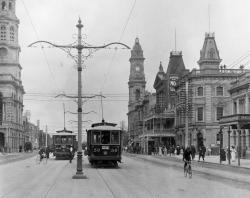
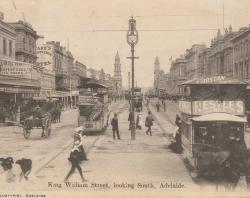
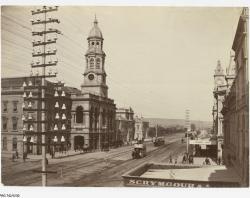
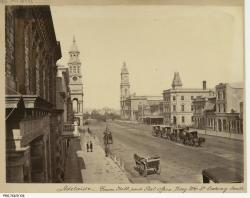
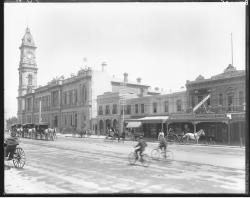
Digging through the State Library’s photograph collections, we can find similar streetscapes and some of the buildings depicted in the illustration.

King William Street looking south, 1909. SLSA: B 3540

King William Street looking south, 1905. SLSA: B 72299

King William Street looking south, 1885. Samuel White Sweet SLSA: PRG 742/5/30

King William Street looking south, 1870. Samuel White Sweet SLSA: PRG 742/5/126

King William Street south of Pirie Street, c 1897. SLSA: PRG 631/2/10
About the book
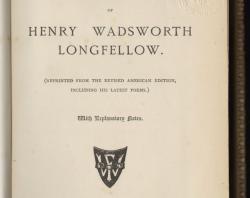
The poetical words of Henry W. Longfellow. The “Albion” Edition. Reprinted from the revised American edition, including his latest poems.
The State Library’s copy was published in London by F. Warne in 1882 and you can view the catalogue record.
Henry Wadsworth Longfellow (1807-1882) was a widely read and beloved American poet of the nineteenth-century, known for verse that was lyrical, reflective, and deeply accessible.
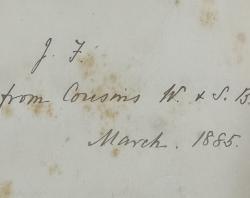
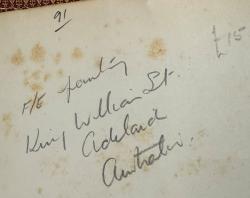
There is no information about who the fore-edge artist might have been or who owned the book prior to the State Library purchasing it for the collection (for £15). The only clues are initials.

The message reads: "J.F. from cousins W. + S.B March. 1885."

Inscription on a page "F/E family King William St, Adelaide Australia" "15 pounds"

Title page of the book:
The poetical words of Henry W. Longfellow. The “Albion” Edition. Reprinted from the revised American edition, including his latest poems.
Written by Laura Wolfe, Digital Engagement Officer