
Preserving Port Lincoln’s Stories
Bringing local newspapers into the digital age
Local newspapers are more than records of daily events; they are the memory of a community. For the Port Lincoln History Group (the Group), the journey to digitising decades of local newspapers began with a simple question, a shared frustration, and a belief that Port Lincoln’s stories deserved to be freely accessible to everyone.
Read the story of how the Port Lincoln History Group provided their local community and South Australia with one of the best local newspaper accesses on Trove in the nation.
Funding the project: a community commitment to local history
In April 2022, the Group embarked on an ambitious mission: to digitise nearly 50 years of the Port Lincoln Times (1955 to 2002) and make it freely available online through the National Library of Australia’s digital platform, Trove. Three years later, that goal has been achieved. At a final cost of $230,000, close to 124,000 pages of local history have been returned to the community, accessible anytime, anywhere.
Browse editions of the Port Lincoln Times on Trove
The spark came from a relatively new group member, Ashley Cowley, who joined the Group in 2017. While researching his family history, he repeatedly hit a frustrating barrier: newspapers published after 1954 were not digitised due to copyright restrictions. After investigating further, he discovered the obstacle could be overcome providing that the permission was secured from the newspaper owners and the funds could be raised to digitise the material.
When Ashley presented the digitisation quotes to the committee, there was a collective gulp. His response quickly became the rallying cry for the project:
“It’s just a number with a lot of zeros after it. We can do this"
~ Ashley Cowley, PLHG member
What is Trove?
Trove is a federally funded digital archive established in the mid-2000s, offering free online access to millions of Australian resources, including newspapers, photographs, maps and more. Early funding enabled many newspapers to be digitised, including the Port Lincoln Times from its first issue in 1927 up to 1954, where copyright restrictions halted progress.
To move beyond that date, explicit permission from newspaper owners was required. The Group proactively sought and secured those permissions, clearing the way for fundraising and digitisation to begin.
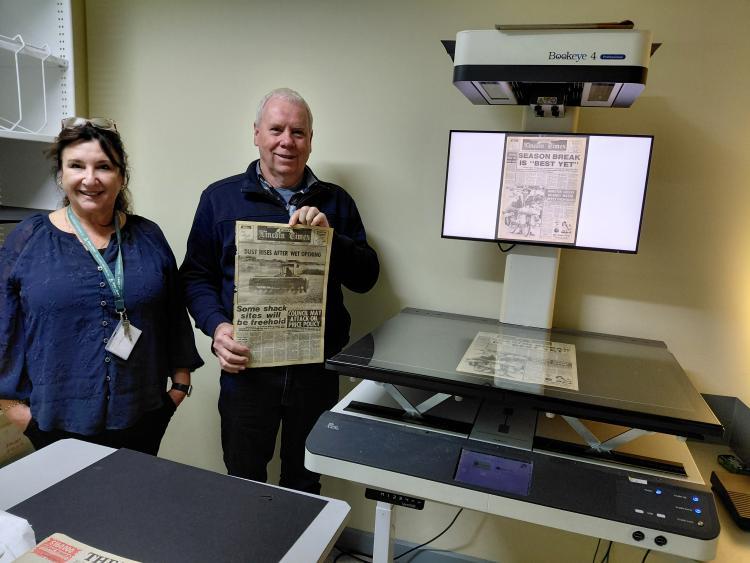
Importantly, the History Group did not undertake the technical digitisation themselves. The work was coordinated through the State Library of South Australia, with digitisation carried out by their contractors in partnership with Trove.
“We did not have to do any of the digitising work; the State Library of SA and their contractors did all that. It was a huge job for them, about 124,000 pages. We are very grateful for the assistance given by SLSA.”
~ Chris Mantle, President, Port Lincoln History Group
Powered by grants, donations and community support
Most of the project funding came from successful grant applications and generous donations, supplemented by a small contribution from the Group’s own fundraising efforts, including proceeds from their popular annual calendar sales. A significant philanthropic donation of $50,000 helped launch the project, followed by several large grants that provided the momentum to carry it through.
Every donation, large or small, helped turn an ambitious idea into a lasting public resource. The group extends heartfelt thanks to all donors for their generosity and belief in the project’s value.
The Group also built on earlier successes. Previous additions to Trove funded by the group included the West Coast Recorder (1904 to 1942). As a result, the community now has continuous online newspaper coverage from 1904 to 2002.
“Special thanks to Nicole Spence, Senior Digitising Officer, at the State Library of South Australia, whose assistance, expertise and patience over the project’s three-year lifespan have been invaluable.”
~ Chris Mantle, President, Port Lincoln History Group
Building awareness, skills and support
The challenge wasn’t only raising funds. Trove itself, despite being an extraordinary national resource, was not widely known or confidently used within the local community. The Group recognised that education would be key to ensuring the digitised newspapers were genuinely used and valued.
“Trove, we have discovered, is not a well-known website, and even if known, there is a reluctance to 'give it a go'. "
~ Chris Mantle, President, Port Lincoln History Group
Free Trove workshops have been offered as part of South Australia’s History Festival over the past few years, alongside one-on-one sessions by appointment. These sessions demonstrated how digitised newspapers could benefit family historians, students, sporting clubs, researchers and community groups and helped build confidence in using the platform.
Free access for everyone, now and into the future
Today, these newspapers are freely accessible to anyone via Trove. They support research into family history, schools, sporting and social life, local industries, from fishing to silos, and countless personal discoveries.
The Group continues to offer education and support for using Trove, reinforcing its role as a powerful community resource, available to all.
What’s next?
The work isn’t finished. With permission now secured from the new owners of the Port Lincoln Times, the Group is preparing to digitise a further five years (2003 to 2007). This next stage is estimated to cost around $40,000, and community donations are once again invited to help extend this living archive.
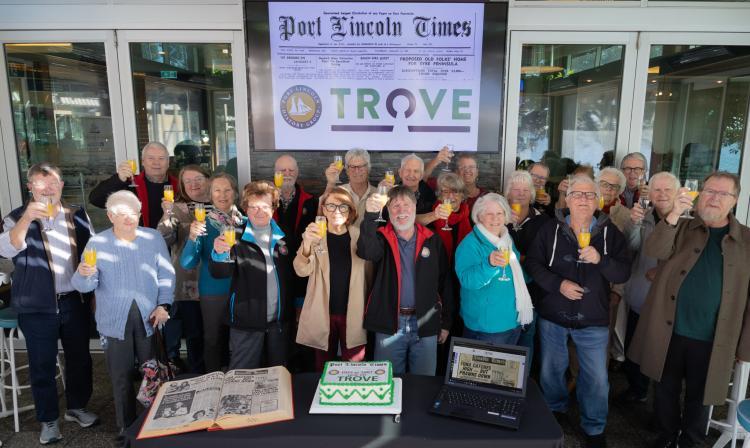
Thanks to the dedication of Port Lincoln History Group and its members, all known Port Lincoln newspaper titles from 1839 to 2002 are now available on Trove. Earlier digitisation of the Port Lincoln Times (1927 to1954) was funded directly by Trove, and no further local titles are currently known to remain undigitised. While other Eyre Peninsula titles exist, the group encourages those communities to pursue similar locally led projects.
Advice for other community history groups
For groups considering a similar journey, Group president Chris Mantle offers the following clear advice:
- Think community-first. Trove is a shared resource, not just a tool for researchers.
- Teach people how to use it. Once people see their own stories reflected in old newspapers, interest grows quickly.
- Don’t fear the cost. It can be done and it can be done at your own pace.
- Aim high with grants and donations. Funders recognise the long-term value of preserving local history.
- Celebrate the outcome. Once digitised, these newspapers are freely available to everyone, forever. A gift to future generations.
A living history group
The passion behind this project reflects the broader work of the Port Lincoln History Group. Since joining in 2017, the current president has helped guide the group through significant growth, from managing the Mill Cottage Museum and History Group to expanding digitisation across photographs, film, slides, negatives and video.
New technologies, improved storage and metadata systems, refreshed museum layouts, audio commentary and hands-on training have all been introduced to ensure the collection remains accessible and meaningful well into the future.
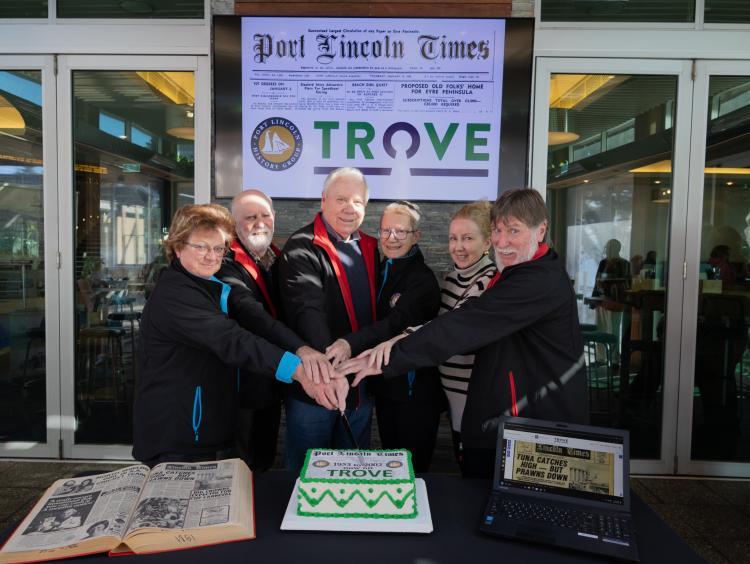
Above all, there is a deep sense of pride in what has been achieved and a shared belief that preserving local stories matters.
Because when history is digitised and shared freely, it doesn’t just belong to the past. It belongs to everyone.
Contributions for this story are from Nicole Spence, the State Library’s Senior Digitising Officer, and Chris Mantle, President of the Port Lincoln History Group. Written by Laura Wolfe, Digital Engagement Coordinator.