

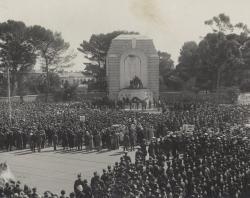
Unveiling of the National War Memorial, corner of Kintore Avenue and North Terrace, Adelaide in 1931. SLSA: B 5909

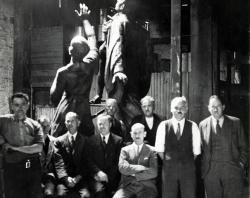
In the workshop in front of the three main figures during the Construction of the National War Memorial, Adelaide, c1929. MH Pulford, photographer. SLSA: BRG 18/54/1/11

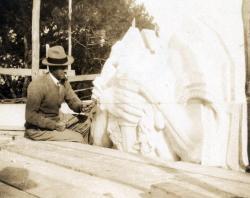
Construction of the National War Memorial, Adelaide, 1929. SLSA: BRG 18/54/1/25

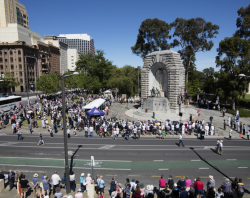
Centenary of the First World War Armistice, 2018. Jenny Scott, photographer. SLSA: B 77213

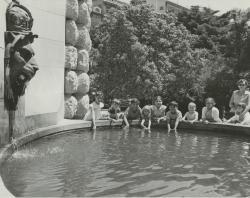
The 'Fountain of Compassion' at the rear of the War Memorial, 1960. Keith Phillips, photographer. SLSA: PRG 1712/3/22
The design
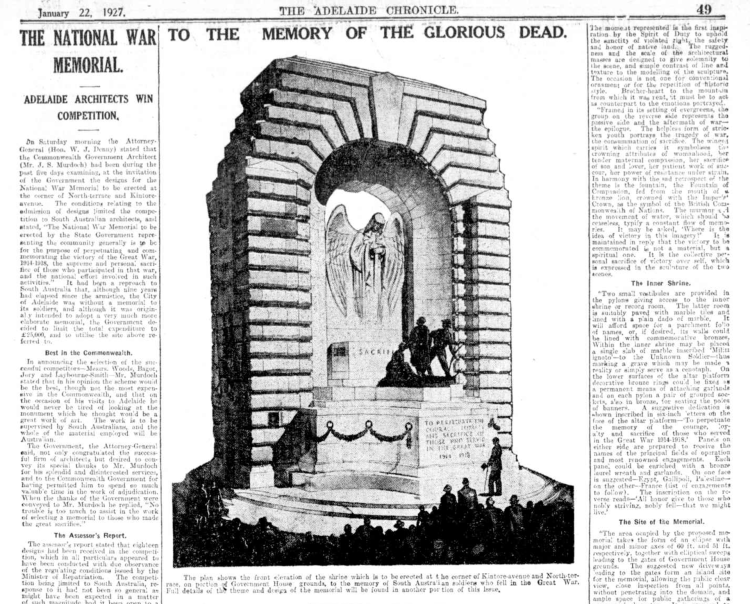
On 17 January 1927 the Attorney General for South Australia, the Hon WJ Denny, announced that of the 18 designs submitted to the National War Memorial Committee, the successful design was that of Architects Woods, Bagot, Jory and Laybourne-Smith. The Adelaide Chronicle on Saturday 22 January 1927 featured a full page spread of the announcement.
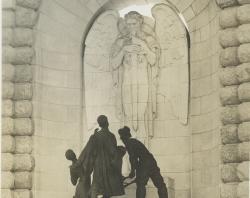
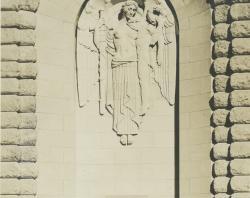
The National War Memorial was designed with two distinct faces, much like the two sides of a coin. Architects Woods, Bagot, Jory and Laybourne-Smith described the two sides as:
"the before and the after,
the active and the passive,
the prologue and the epilogue of war."
One side features the Angel of Duty, watched by a farmer, a student and a young woman, symbolising service, sacrifice and the call to serve. On the other, the Angel of Compassion cradles a fallen soldier, reflecting the grief, loss and human cost of war.
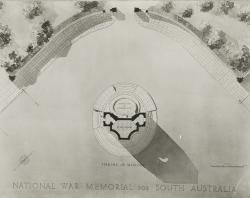
The architectural firm’s brochure of the memorial proposes that the axis of the proposed site be diagonally rotated north-west. This was to provide varied light throughout the day and also to place it on the same angle (though not alignment) as the Women’s Memorial Cross of Sacrifice, and St Peter’s Cathedral in North Adelaide. This would mean that 'in a view from an elevated position the War Memorial would form a proper terminal to the long vista.'

Construction of the National War Memorial, Adelaide, c1930. D Darian Smith, photographer. SLSA: BRG 18/54/1/22

Construction of the National War Memorial, Adelaide, c1930. D Darian Smith, photographer. SLSA: BRG 18/54/1/23

Plan of the National War Memorial, Adelaide, c1928. SLSA: BRG 18/54/1/2
The construction
Grey Harcourt granite and white marble, as well as reinforced concrete, were used in the construction of the monument.
The sculptors used white marble for the two sides, and bronze was used for the three figures and the lion’s head waterspout.
View a selection of photographs showing the construction of the National War Memorial.
The hidden coin
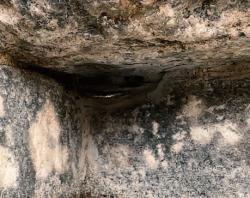
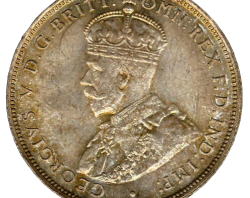
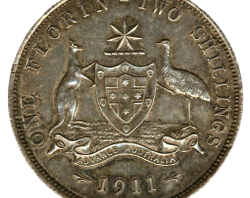
Adding to its story is a hidden Australian florin concealed within the Memorial. At the time, it was common to place coins beneath foundation stones or inside new buildings and monuments, a tradition linked to older customs of leaving objects for protection, luck and remembrance. In war memorials, such coins often served as a quiet tribute to those who had fallen.

Close up of the florin tucked into the mortar in the War Memorial.

Australian florin, obverse side, courtesy of Museums Victoria.

Australian florin, reserve side, courtesy of Museums Victoria.
Next time you pass Adelaide's National War Memorial, take a closer look. You might not find the hidden florin, but you'll discover a monument rich with symbolism, history and remembrance.
More to explore
The National War Memorial for South Australia - brochure compiled by Woods, Bagot, Jory & Laybourne-Smith, Architects, Adelaide SLSA: South Australia Collection
Woods Bagot Pty Ltd SLSA: BRG 18
Why coins are put under foundation stones, Bendigo Advertiser, 14 Dec 1903