
Behind the Bind
Revealing a boat, a bookbinder and a bookstore
An incredible ocean scene lies concealed beneath the shimmering gold edges of Rhymes for the Romantic and Chivalrous by the anonymous author D.W.D., published in 1836. Yet as our research unfolded, we discovered that this stunning fore-edge painting was only the beginning!
The book held an even biggest secret waiting to be revealed.
At first glance, the hidden fore-edge painting seemed to fit the book perfectly. The scene depicts a fleet of ships, surrounded by smaller boats, which echoes the many maritime illustrations used within the book of an ocean voyage. The book came to the State Library through the Paul McGuire Maritime Library and was published in London in 1836, the year South Australia was declared a province.
One detail, however, didn’t add up. The blue ensign appears in its pre-1801 form lacking the Saint Patrick cross that was added to the Union Flag in 1801. How could a single illustration contain clues from two different eras? What first seemed like a straightforward maritime scene had suddenly become a historical mystery.
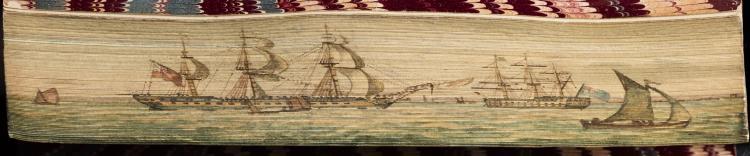
A possible explanation is that the artist took creative liberties in the case of the blue ensign. Although the painting appears to reference an earlier version of the flag, the post-1801 design was already the official model by the time the book was published in 1836. This suggests that historical accuracy may not have been the artist’s primary concern, adding yet another layer to the mystery surrounding the fore-edge painting.
Finding a name and bookbinder
While searching for clues in the look for hints on who the mysterious fore-edge artist might have been we found a hidden unexpected clue to this book’s own history. Hidden in the top corner of the front-end page was a name:
‘A. CHATELIN’
This small inscription opened a new chapter in the book’s journey and sent our research in an entirely new direction. It offered a glimpse into one of the people who may have owned, handled, or helped shape the book’s path before it eventually found its way into the collection.
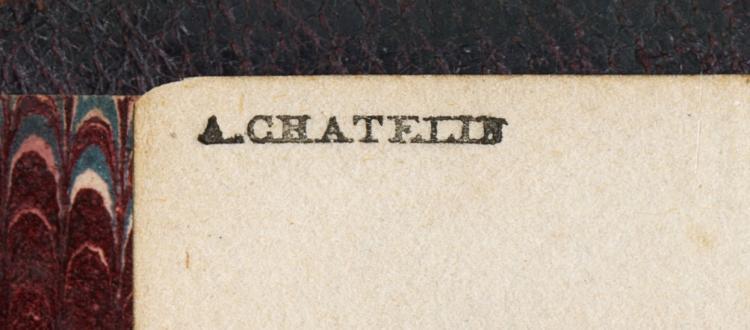
At first, we wondered whether ‘A. CHATELIN’ was the name of the book’s original owner. During this period, it was common for books to include a list of subscribers, or for the owners to have their name printed or inscribed inside special copies, especially first editions. However, the placement of this inscription did not match where a subscriber’s name would typically be placed, nor did its small size resemble a traditional ownership mark.
Which raised a new question... If it was not an owner’s name, why was it there?
Discovering the bookbinder
Our research revealed that bookbinders often left their own marks on books that they worked on. Following this clue, we discovered that A. Chatelin was in fact Antoine Chatelin, French-born bookbinder who moved to London and established himself there.
Chatelin had moved to London after being exiled in 1852 following the political upheaval surrounding the French Revolution in 1848 and the rise of Napoleon III. Before his exile, he had been active supported and member of the revolution, penning letters and co-authoring Pamphlets with well-known socialists including Felix Pyat, and Gustave-Auguste Besson.
Our research led us to compare examples of Chatelin’s other works, which revealed a match. The same name stamp, in the same font and size appeared in other books that he had bound. This confirmed that the tiny inscription hidden inside Rhymes for the Romantic and Chivalrous was likely the mark of Chatelin.
His reputation as a bookbinder grew and by the time of the 1862 International Exhibition, was recognised for his exceptional craftsmanship, receiving an award for his hand tooling and fine finishing work in the category of old-printed books, mended and rebound.

However, one mystery remains. When the book was published in 1836, Chatelin would have been 16 years old, making it unlikely that he was responsible for the original binding. As the book was published and sold in London, the most likely explanation is that the book was rebound later in its life, possibly after Chatelin established his own binding business at 15 Newman street just off the corner of Oxford Street, in 1852.
The initial in the book
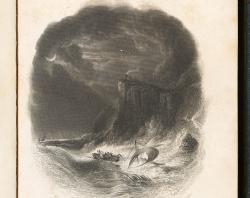
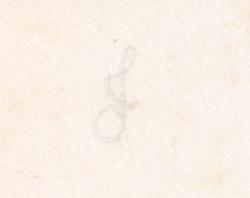
We discovered more clues within the book through our research which revealed more of the books journey. Book sellers would also often mark the first and last pages of a volume before sale, which was to confirm that all pages were pages were present and in order. In this case, the initials found inside the book correspond with the bookseller’s label attached to the back endpaper.

The title page of the book with the J initial inscribed just below the illustration on the left.

The initial J seem on the title page of the book.
The Bookstore label
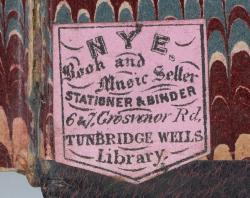
The label reveals the bookseller as Joseph Henry Nye and this little clue suggests that before reaching Chatelin’s workshop, the book passed through Nye’s store, where it was prepared for sale.
Nye’s Book and Music Seller
Stationer and Binder
6 & 7 Grosvenor Road
Tunbridge Wells
Library

The label attached by 'Nye Book and Music Seller, Stationer & Binder. 6&7 Grosvenor Rd, Tunbridge Wells Library.

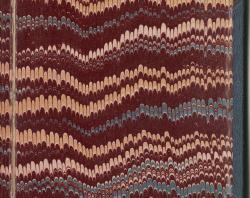
The back of the showing the little Nye label.

J.H.Nye advert in the Kent & Sussex Courier, 08 April 1887. The British Newspaper Archive
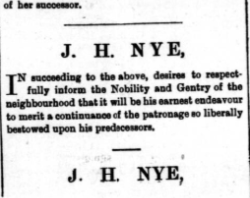
Based on newspaper reports, the book may have entered Nye’s business from around 1872 when Joseph Henry Nye was reported to have begun work at his parents’ stores. At some point after this, the book appears to have travelled to Chatelin’s workshop, where it received its new binding and his identifying mark.
While we still do not know exactly how the book travelled to Adelaide, or who owned it along the way, these discoveries have revealed a remarkable first chapter in its history. Hidden beneath gold edges and within tiny handwritten clues, the book carries the stories of its makers, sellers, and keepers, each leaving behind a trace of its incredible journey through time.
Written by Aimee Heidrich, Intern, Engagement and Marketing